Sesame Sourdough Ciabatta
By From Luxembourg With Loaf · Last edited Nov 21, 2026

Sesame Sourdough Ciabatta
By From Luxembourg With Loaf · Last edited Nov 21, 2026
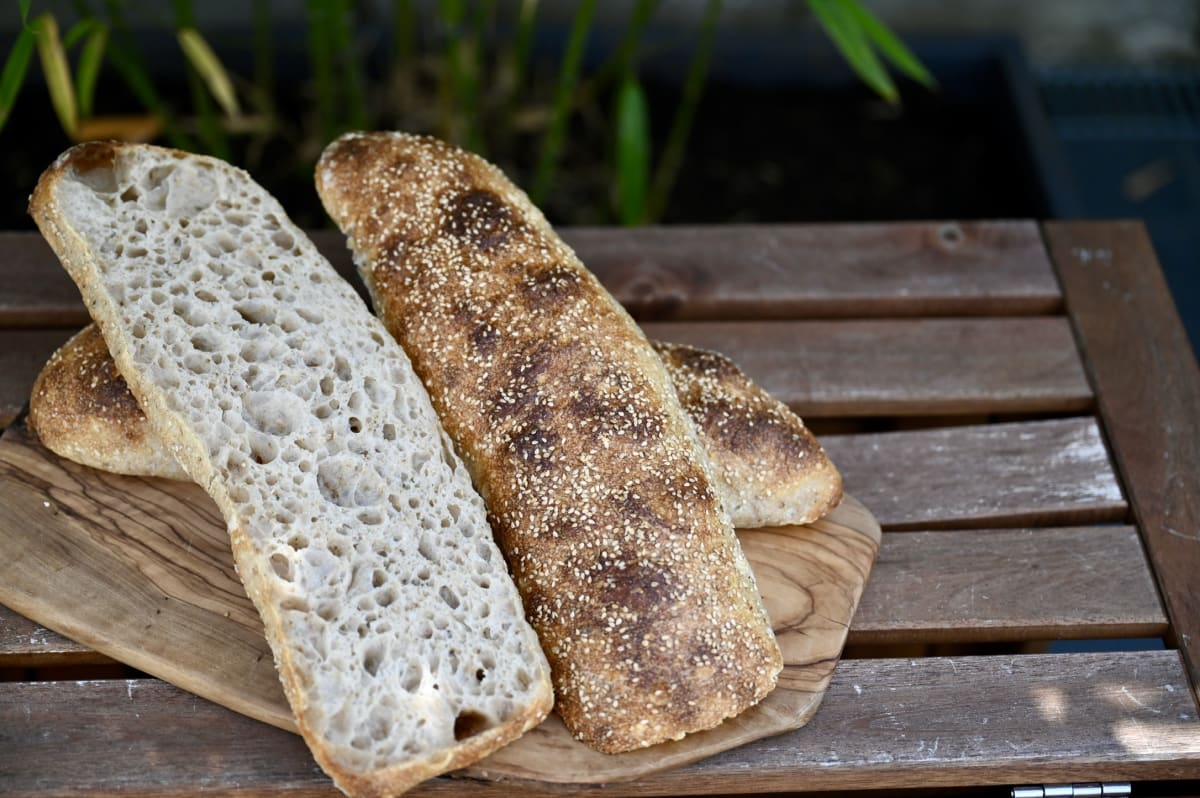
Let me tell you, I am obsessed with ciabatta! This is actually my fourth ciabatta recipe on the channel, but that's because it's the perfect bread to play around with. Why? Because unlike some breads, ciabatta doesn't require a ton of shaping knowledge. You literally just dump the dough on your counter, divide it, and bake it! Easy peasy. Plus, for this recipe, I've added roasted sesame seeds which take the flavor profile to a whole new level. Seriously, this sesame sourdough ciabatta is the perfect summer bread - light, airy, with a beautiful crust and an extra flavor boost from the toasted sesame seeds. So ditch the store-bought stuff and let's bake some amazing ciabatta together!
- Total weight
- 2,232g
- Yield
- 4units
- Unit weight
- 558g
- Hydration
- 82%
- Total time
- 18 h 50 min
Ingredients
Levain
208gToasted Seeds
200gMain dough
2,232gTaste Profile
Dominant notes: Lactic / Dairy, Acetic / Sour, Nutty / Roasty
Nutrition facts 236 kcal per 100 g · estimated
| Nutrient | Per piece (of 4) | Per 100 g |
|---|---|---|
| Energy | 1,119 kcal | 236 kcal |
| Fat | 15.8 g | 3.3 g |
| of which saturates | 2.3 g | 0.5 g |
| Carbohydrates | 203.2 g | 42.8 g |
| of which sugars | 1.7 g | 0.4 g |
| Fiber | 12.7 g | 2.7 g |
| Protein | 36.7 g | 7.7 g |
| Salt | 5.98 g | 1.26 g |
AI estimate based on the ingredients. Per 100 g assumes the bread loses 15% of its dough weight in the oven. Not a substitute for lab-tested label values.
Process
Levain Preparation
11 h 45 minThe evening before baking, mix the rye flour, water, and rye sourdough starter. Cover and let sit at room temperature to mature.
Flavor Booster Preparation
10 minRoast the sesame seeds in a pot until they begin to jump. Carefully add the water to the hot seeds to create a flavor booster. Set aside to cool.
Initial Mixing
10 minCombine the flour, the prepared levain, and the first 600g of water. Mix until a cohesive dough forms.
Final Mixing and Development
15 minAfter 10–15 minutes of initial mixing, add the roasted sesame mixture, salt, and the remaining 200g of water (poured in slowly). Increase the mixer speed and develop the dough for 5 minutes until strong and elastic.
Initial Shaping and Resting
30 minTransfer the dough to a clean countertop, form into a smooth ball, and place into a well-oiled container. Let rest for 30 minutes.
Coil Folds
2 hPerform one set of coil folds. Over the next 2 hours, perform 4 additional sets of coil folds every 30 minutes to build dough strength.
Bulk Fermentation
3 h 30 minAllow the dough to rest undisturbed for 2–4 hours, or until it has doubled in volume.
Division and Final Shaping
15 minGently turn the dough onto a floured surface. Divide the dough into four equal parts. Maintain the airy structure by avoiding heavy handling or degassing.
Baking
25 minBake the loaves in two phases as specified below.
Phase 1: Bake for 15 minutes with steam.
Phase 2: Bake for 10 minutes with steam released.
Fermentation estimate
Calculated from this recipe's levain, salt and hydration with Bill Wraith's sourdough rise model.
- Pre-fermented flour
- 9.4%
- Salt
- 2.2%
- Hydration
- 81.9%
This recipe's schedule
Reaches 8% of the model's target. The model has it done after 5 h.
Reaches 253% of the model's target. The model has it done after 2 h 30 min.
Steps without their own temperature use the temperatures above.
An estimate. Starter vigour, flour and dough temperature drift all move it, so watch the dough, not the clock. Source: Bill Wraith, Sourdough Rise Time Modelling (2007)
Community
Log in to share your thoughts or bakes.
Log in to participate