Walnut Sourdough Bread
By From Luxembourg With Loaf · Last edited Nov 21, 2026

Walnut Sourdough Bread
By From Luxembourg With Loaf · Last edited Nov 21, 2026
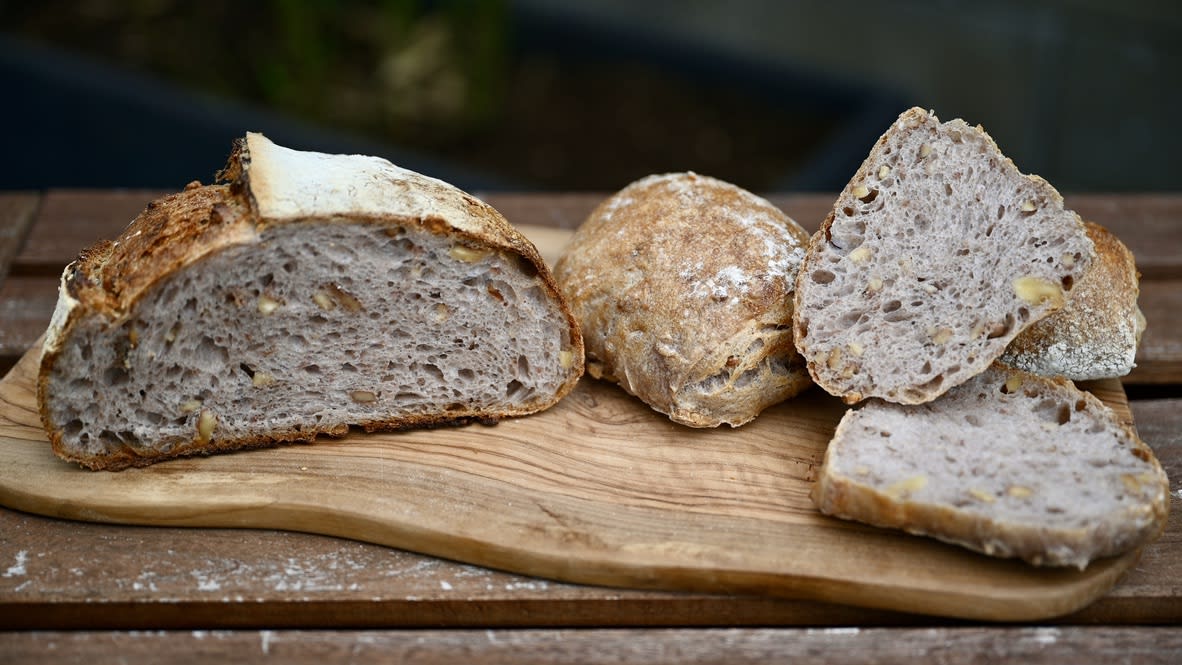
Sourdough in combination with nuts is simply unbelievably good. The light acidity of the bread combined with the incredible aroma of walnuts was at the top of my bucket list. Now I have fulfilled my wish and developed a walnut sourdough bread. And as if that wasn't enough, I've also included a simple way to make bread rolls from it.
- Total weight
- 1,774g
- Yield
- 2units
- Unit weight
- 887g
- Hydration
- 80%
- Total time
- 37 h 20 min
Ingredients
Levain
168gMain dough
1,774gNutrition facts 284 kcal per 100 g · estimated
| Nutrient | Per piece (of 2) | Per 100 g |
|---|---|---|
| Energy | 2,144 kcal | 284 kcal |
| Fat | 60.1 g | 8 g |
| of which saturates | 6.1 g | 0.8 g |
| Carbohydrates | 343.9 g | 45.6 g |
| of which sugars | 4.3 g | 0.6 g |
| Fiber | 23.2 g | 3.1 g |
| Protein | 57.4 g | 7.6 g |
| Salt | 7.93 g | 1.05 g |
AI estimate based on the ingredients. Per 100 g assumes the bread loses 15% of its dough weight in the oven. Not a substitute for lab-tested label values.
Process
Levain Preparation
11 h 15 minMix the wheat flour, water, and sourdough starter. Cover and leave at room temperature overnight (approximately 12 hours) until active.
Initial Mixing (Autolyse/Incorporate)
10 minIn a stand mixer, combine the wheat flour, rye flour, the majority of the water, and the levain. Mix at low speed for 10 minutes.
Final Mixing
5 minIncrease the mixer speed. Gradually add the salt and the reserved water. Continue mixing for 5 minutes until the dough is smooth and shows good gluten development.
Inclusions
5 minAdd the roasted walnuts to the mixer. Mix on low speed for 2 minutes until the nuts are evenly distributed throughout the dough.
Bulk Fermentation & Strengthening
2 hTransfer the dough to a greased container. Let it rest for 30 minutes. Perform one set of coil folds every 30 minutes for the next 2 hours (4 sets total).
Ambient Fermentation
4 h 30 minAllow the dough to ferment undisturbed at room temperature for 3 to 6 hours, depending on the activity of the dough and room temperature.
Dividing & Preshaping
30 minGently turn the dough onto a floured surface. Divide as desired (for loaves or rolls) and preshape into rounds. Let the dough relax for 30 minutes.
Final Shaping
15 minShape the dough into its final form and place into floured bannetons.
Cold Proof
17 h 10 minCover the dough and place in the refrigerator for a cold overnight proof to develop flavor and acidity.
Baking (as bread)
45 minBake the dough onto a preheated pizza stone
Baking (as rolls)
35 minDivide dough into 4-6 pieces
Fermentation estimate
Calculated from this recipe's levain, salt and hydration with Bill Wraith's sourdough rise model.
- Pre-fermented flour
- 9.5%
- Salt
- 1.8%
- Hydration
- 79.6%
This recipe's schedule
Reaches 139% of the model's target. The model has it done after 4 h 50 min.
Reaches 758% of the model's target. The model has it done after 2 h 20 min.
Steps without their own temperature use the temperatures above.
An estimate. Starter vigour, flour and dough temperature drift all move it, so watch the dough, not the clock. Source: Bill Wraith, Sourdough Rise Time Modelling (2007)
Community
Log in to share your thoughts or bakes.
Log in to participate