Sourdough Shokupan
Von From Luxembourg With Loaf · Zuletzt bearbeitet 21. Nov. 2026

Sourdough Shokupan
Von From Luxembourg With Loaf · Zuletzt bearbeitet 21. Nov. 2026
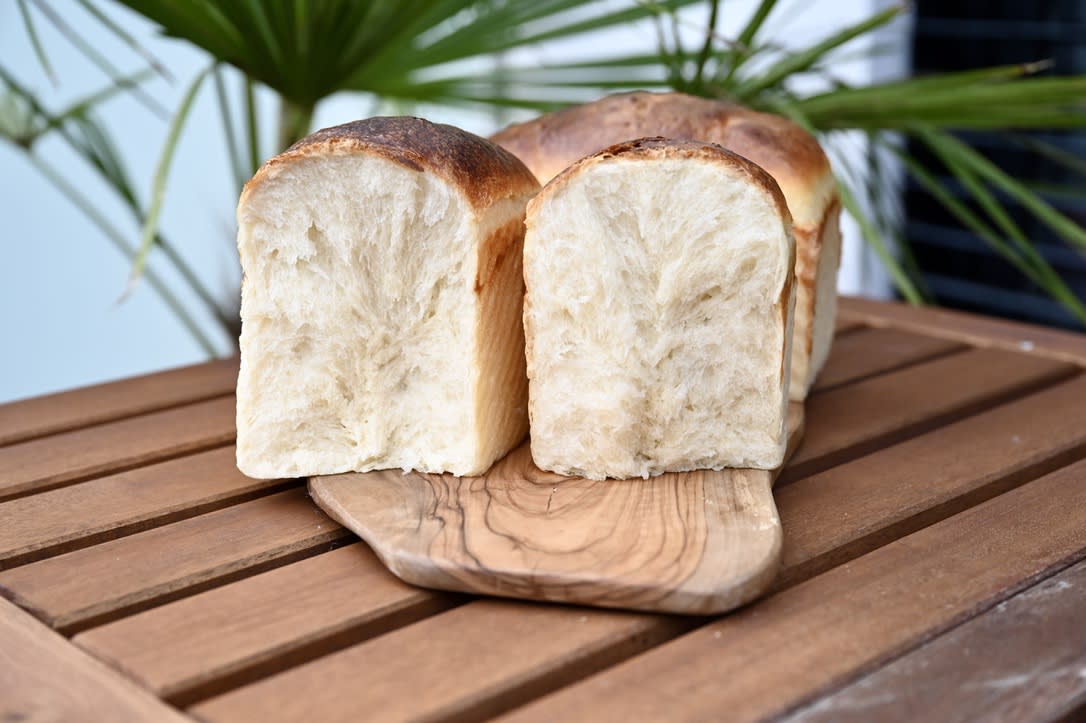
I've always wanted to bake shokupan bread. This Japanese milk bread, super soft and fluffy, is shown again and again on social networks. So it was time to develop my own. I used a tangzhong to get as much moisture into the dough as possible.
- Gesamtgewicht
- 1,600g
- Ausbeute
- 2Stück
- Stückgewicht
- 800g
- Hydration
- 58%
- Gesamtzeit
- 21 Std. 55 Min.
Zutaten
Tangzhong
240gSweet Stiff Starter
350gMain dough
1,600gNährwerte 299 kcal pro 100 g · geschätzt
| Nährstoff | Pro Stück (von 2) | Pro 100 g |
|---|---|---|
| Energie | 2.036 kcal | 299 kcal |
| Fett | 37,4 g | 5,5 g |
| davon gesättigte Fettsäuren | 20,1 g | 3 g |
| Kohlenhydrate | 362,3 g | 53,3 g |
| davon Zucker | 41 g | 6 g |
| Ballaststoffe | 11,4 g | 1,7 g |
| Eiweiß | 54,3 g | 8 g |
| Salz | 5,27 g | 0,78 g |
KI-Schätzung auf Basis der Zutaten. Pro 100 g geht davon aus, dass das Brot beim Backen 15 % seines Teiggewichts verliert. Kein Ersatz für laborgeprüfte Nährwertangaben.
Prozess
Prepare Starter
5 minCombine all starter ingredients in a container. Mix thoroughly and ferment overnight at room temperature.
Prepare Tangzhong
5 minCombine water and flour in a pan over moderate heat. Stir continuously until thickened. Transfer to a glass container, cover with plastic wrap, and refrigerate overnight.
Initial Mix
10 minCombine flour, milk, sweet stiff starter, and tangzhong in a mixer. Mix on slow speed for 10 minutes.
Dough Development
35 minAdd eggs, butter, and sugar. Increase to a higher speed and mix for 5 minutes. Incorporate salt and mix for an additional 1–2 minutes until the windowpane test is passed.
Bulk Fermentation
5 h 45 minTransfer dough to a countertop for initial slap and folds, then place into a plastic container. After a 30-minute rest, perform 4 sets of coil folds, spaced 30 minutes apart, allowing the dough to rest between each set. Total fermentation time: 3–4 hours.
Dividing and Shaping
5 minDivide the dough into 6 equal portions (approx. 270g each). Shape into rolls and place into a loaf pan.
Final Proof
2 h 25 minCover the pan and proof for 2–4 hours until the dough reaches the top of the loaf pan.
Glazing
10 minBrush the tops of the loaves with the egg wash mixture (1 Egg yolk & Dash of milk).
Baking
45 min250°C (482°F). Note: Consider reducing to 220°C/428°F for a thinner crust.
Insert loaves, add steam, and immediately reduce temperature to 180°C (356°F). Bake for 45 minutes.
Gärzeit-Schätzung
Berechnet aus Levain, Salz und Hydration dieses Rezepts mit Bill Wraiths Sauerteig-Gärmodell.
- Vergärtes Mehl
- 24.3%
- Salz
- 1.2%
- Hydration
- 58.6%
Zeitplan dieses Rezepts
Erreicht 216 % des Modellziels. Laut Modell fertig nach 3 Std.
Erreicht 101 % des Modellziels.
Schritte ohne eigene Temperatur verwenden die Temperaturen oben.
Eine Schätzung. Kraft des Anstellguts, Mehl und schwankende Teigtemperatur verschieben sie. Achte auf den Teig, nicht auf die Uhr. Quelle: Bill Wraith, Sourdough Rise Time Modelling (2007)
Community
Log in to share your thoughts or bakes.
Log in to participate